
The fight between Tom of Finland’s muse and his foundation threatens the future of an erotic art collection worth millions.
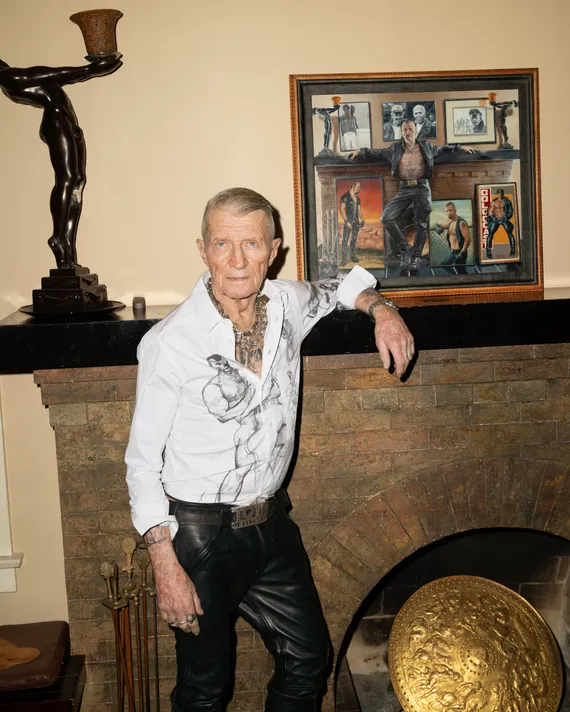
Durk Dehner, the public face of the Tom of Finland Foundation for over 40 years, in 2025. Portrait of Durk by Suzanne Shifflett. Photo: Elliott Morgan.
For four decades, the Tom of Finland Foundation was headquartered in a 1911 craftsman house in the Echo Park neighborhood of Los Angeles that is stuffed with the artist’s illustrations of leather-uniformed men flashing rippling chests and throbbing bulges. The work of other erotic artists lines the walls, and the ceilings are covered with frescoes of nude angels exchanging oral sex. A library holds thousands of vintage gay magazines such as Drummer and Honcho, and in the backyard is the Pleasure Park, a cruising ground and sculpture garden that has its own swing. “You could not possibly count the number of dicks on display,” says Carta Monir, who lived there as part of the foundation’s artist-in-residency program. “As a trans woman, I was very ready for it to be a very gender-essentialist experience. And it was wonderful. No weirdness; no discomfort. Incredibly welcoming. Durk gave us the first tour, actually.”
Durk is Durk Dehner, who bought the house in 1979 with his boyfriend, ex-boyfriend, and ex-boyfriend’s boyfriend. He met Tom of Finland in the late 1970s, and, for a time, they had a sexual relationship; mostly they were friends. Whenever Tom came to America, he stayed in a room on the third floor [attic], sometimes for six months at a time. He and Dehner went into business together, first through a business partnership that split the revenues from licensing Tom’s imagery into Tom of Finland-branded products, and later by forming the Tom of Finland Foundation to oversee his work and papers. After Tom’s death in 1991, control of the foundation passed to Dehner, who ran it as a scrappy community hub, offering beds to artists and other castaways at the height of the AIDS epidemic.
Dehner convinced the German publisher Taschen to print several books of Tom of Finland’s work, got the government of Finland to put Tom of Finland on its official stamps, and, in addition to thousands of Tom originals, amassed a collection of queer erotic art spanning 6,000 works by over 800 gay artists, including Robert Mapplethorpe, Jean Cocteau, Bruce Weber, George Quaintance, and Michael Kirwan, whose ashes were planted at the base of a citrus tree in the backyard of this house. In all, the collection is estimated to be worth at least $40 million. Now 77, Dehner sees promoting Tom’s work as his life’s mission. “I was the tool for a gift, and the gift was Tom of Finland, and I wanted him to utilize me,” he says.
Then, last year, Dehner was pushed to resign as president of the foundation and to give up his seat on the board of directors. He had always been more of a public face than a traditional nonprofit director—the foundation, which never had more than a few hundred thousand dollars in assets, spent more money than it took in [Lists ToFF as a New York, NY organization] for three years in a row starting in 2021. But the reason for the dismissal was a recent photo Dehner had submitted as part of an application to judge an International Mr. Leather contest that featured him wearing a leather S.S. hat. He maintains the outfit was fetish-wear, not an act of hate speech. “My own board threw me under the bus, and didn’t give me a chance for any rebuttal, and that was unfair and not democratic,” he says. “But the way cancel culture works is that it isn’t democratic. It’s just: Off with your head.”
With his partner S.R. Sharp, who was then vice-president of the foundation, Dehner recruited new board members he hoped would be sympathetic to his cause. But the effort didn’t work out as planned. The new board members, a group of New Yorkers with limited nonprofit experience, encountered what they perceived as a mismanaged organization and seized control in order to course-correct. This past summer, they stopped paying rent on the house, fired most of the staff, and filed a complaint with the attorney general of California accusing Dehner of collecting royalties they said belonged to the foundation.
Dehner, who denies the charge, fired back with a website, Save TOM House, calling for the board’s ouster. The campaign has found favor among former artists-in-residence and employees, who have taken their grievances to social media. “It was almost like a private equity firm came in and just wanted to pick off all the social cachet and use the brand and use our resources for their own social gain,” says Craig Pratt, who worked part-time at the foundation last year.
 A 1980 portrait of Dehner by Tom of Finland.
Illustration: Tom of Finland, Courtesy of Durk Dehner
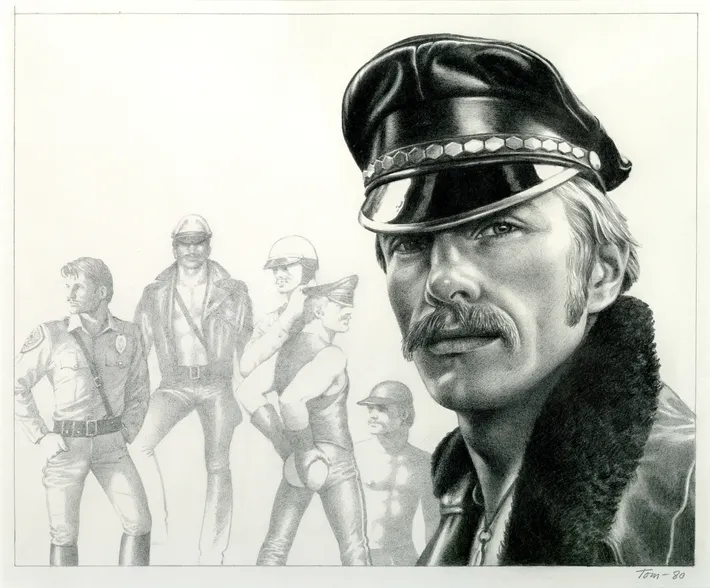 A 1980 portrait of Dehner by Tom of Finland.
The dispute between the board and the longtime caretaker has left the foundation on the brink of collapse and the original work of a seminal gay artist hidden from public view in a storage facility in downtown Los Angeles. The board of directors continues to fundraise as it looks for a permanent home for the nonprofit. For Dehner, who is at work on a book about his life with Tom, regaining control of the organization he cofounded is a deeply personal crusade. “This house has a kind of spirit that is very special, and when people come here for events, they feel it and they actually contribute to it. It really is about them feeling that they can be themselves, they can be anyone they want to be, and it’s okay here,” he says. “TOM House is not just a building. It’s an organic energy source.”
The organization’s staff never amounted to more than six people, and the foundation budget was always below $1 million — often well below. Many of those who passed through the house spoke fondly of their experience. José Tinoco, who started volunteering at the foundation in 2019 before taking a full-time job there, often went to Dehner and Sharp for advice about dating and sex; on his 21st birthday, before a night out at the the Eagle, Dehner and Sharp gifted him a pair of leather motorcycle pants and a leather wrist cuff. “They walked me down the stairs like I was going to prom,” Tinoco says. Carta Monir once invited a photographer over who was interested in working with her. She walked naked around the house, posing for photos while staffers and volunteers worked. “People were making lunch, and there was some kind of business meeting going on, and nobody even blinked,” she says. “That’s just the kind of environment it is.”
The board members are themselves not frequent donors, which has led to complaints from staff. “These social climbers from New York were really just doing nothing but stripping the foundation and the brand of its social value, and using that to parlay into parties that really turned into nothing,” Pratt says. Robert Knox Hayes has only given $1,000 since joining the board in 2024. “I’m a young professional, and I don’t come from a rich family,” he says.
When we spoke in October, Dehner was plugging away on his book about Tom, though he was reluctant to share the title because he was afraid someone would steal it. Even if he isn’t able to wrest back control of the foundation from the board, he plans to partner with other nonprofits to continue programming. He’s not retiring or going anywhere, that much is certain. He tells me that Tom, right before he died, warned him that running the foundation might take a toll. “If it gets too difficult, just walk away,” Tom advised. Dehner disagreed. “I’ve been through turbulent times here before. I could never walk away,” he says.
SUBSCRIBE TO READ THE COMPLETE NEW YORK MAGAZINE ARTICLE BY MICHAEL WATERS
To ensure our community, supporters, and the public have an accurate understanding of the history, legal structures, and current operations, we are providing the following clarifications.
Editor’s Notes:
–Dehner had personally collected 50 percent of the licensing royalties, per the terms of a 1984 partnership agreement with the artist. In his 1991 will, Tom passed his 50 percent share down to Dehner in writing; Durk gave half of the royalties to the foundation.
-“Hayes also claimed that a 2024 memo of understanding, which was intended to resolve the decades of legal and financial murkiness and to formally grant Dehner his 50 percent cut of all licensing royalties, was not valid because the board did not vote on it. (Dehner and Sharp maintain that the previous board actually had approved of the memo.)” [Clarification: It was also signed by the chairman of the board].
-While Tom loved the sunshine, artistic community, and freedom he found in Los Angeles—and wished to pass away at TOM House—returning to Finland gave him access to his home country’s stronger public healthcare system as his chronic illness required ongoing care. He died in his apartment in Helsinki on November 7, 1991, not at TOM House.
-The current Tom of Finland Foundation website does not direct to a Membership program.
-Although TOM House is quieter than it has been, it remains a vital, active cultural haven. We still have several artists-in-residence, an active crew of volunteers, a part-time digital archivist, we receive visitors to the library and give tours to guests, curators, artists, and friends. Our wise and beloved Loyalty still makes lunch for our community every day—today he served ten of us!