
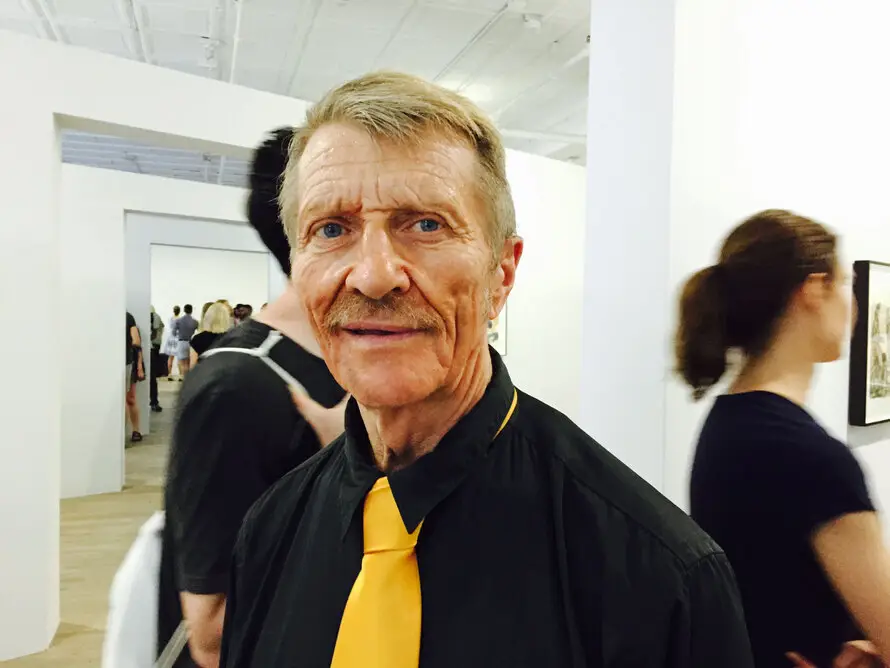

Durk Dehner and S.R. Sharp at the Tom of Finland exhibition in 2015 at Artist Space in New York.
Photos: Jon Voss
The Tom of Finland Foundation’s Board of Directors has moved original works from TOM House and paused the residency programme, which we have written about before.
Now the founder Durk Dehner and partner S.R. Sharp in his first joint interview with QX about the conflict, why they continue to receive artists in the house and that the lawyers are trying to find a solution.
QX has, as yet only the only European rainbow media, followed the harrowing conflict between the now New York-based board of the Tom of Finland Foundation (ToFF) and its cofounder Durk Dehner who lives in the house known as TOM House in Echo Park, Los Angeles. A conflict that has arisen after Durk Dehner and his partner S.R Sharp left the board of ToFF and new people thus gained power.
Now that the new board of ToFF has chosen to move original works by the artist Tom of Finland (born Tuoko Laaksonen) from TOM House to what is described as a safer storage and stop paying out rent to TOM House, the conflict has become completely public.
On Tuesday, QX was given the opportunity to interview Durk Dehner and S.R. Sharp about the board’s decision, the relocation of artwork and the future of TOM House. They also tell us that the lawyers are now trying to find a solution.
How did the board take over?
Durk Dehner: It formally went through votes. Two board members left, including Sharp and another member. Five were still there, and they already had a majority. They started voting in line with the direction they wanted. “When I left the board, it was under pressure. I left voluntarily, but would possibly have been asked to leave if I hadn’t. I had no voting rights left on the board. My view is that they wanted to separate the foundation from TOM House and from me.
What do you think is running the new board?
Sharp: I think they have a different picture of what the foundation should be: more brand building, more polished and more focused on prestige. Not as community-driven.
We are more than a brand. We have made collaborations with the fashion world and been shown in major museums, but we have also had community groups that meet in the house, conversations about difficult topics and workshops on physical and mental health. We have many different programs and are here for our community.
Dehner: It is a bit misleading to describe us as merely attached to the Leather world. The leather clubs and uniform associations were there from the beginning and still have events here. But our reach has always been broader.
A large part of the criticism that is directed at the new board of ToFF is that they ended the Artist-in-Residence Program, the opportunities for new artists to study, as many have been able to do and still do in Durk Dehner’s home, TOM House. Durk himself refers to the open letter that almost all previous artists-in-residence wrote earlier this fall. Artists that Dehner says gave TOM House great support.
– “They demanded transparency,” he said. They were very vocal and thus got the board to reveal that they wanted to move the foundation (all new board members live in New York), stop programs and member activities and organize it in a different way.
ToFF’s new board writes on its website that the foundation’s structure and location are changing. But there are no concrete plans described, which, among other things, the art scholar Berndt Arell voiced criticism of in QX. Even Sharp expresses criticism for what he sees as inaction on the part of the board.
“We had worked on an exhibition in the UK and an art and culture festival in Japan. The festival we had planned for a year and it would not cost the foundation anything. The board dismissed both projects, he said.
QX has emailed follow-up questions to the board that have not been returned.
[Ed. The ToFF Board has conducted a survey but we do not see that the results have been made public at this time.]
What’s left of works of art at TOM House?
Dehner: In addition to works by Tom, there are about 6,000 works of other artists left here that have been catalogued. We are taking care of them.
Sharp: The library is still here, too. Our librarian works here with five other volunteers. Some of the works are loaned to the foundation from Durk’s and my private collections. I was thinking they would be permanent loans. I thought the foundation would always be here.
What does it mean that Tom’s work is now stored elsewhere?
Dehner: They are protected, but not available.
Sharp: Durk has knowledge of the individual works and how they belong together. He worked on a conservation project that has now ceased. The artists also cannot access the works to study them. It is good that the art is stored safely, but it is unavailable to those who need it.
We used to have some works up in the house and rotate them with the ones in storage, so that visitors could see originals. In addition, the house itself is also part of the collection. Next to Tom’s art, that’s the most important part. How often is there a dwelling where the artist himself has lived and worked?
Dehner: Tom is in the walls here.
How does Tom of Finland Company relate to ToFF and who controls the publishing rights?
Sharp: The company and the foundation are two separate organizations. Tom and Durk started the company first, and the proceeds from there helped build the foundation. The publishing rights now lie with ToFF because Durk left them to give the foundation its own source of income. Durk has not worked with the company as much in years; his focus was on the foundation.
Are you continuing with the residency program?
Dehner: Yes. ToFF has paused its program, but we have had to run the Artist-in-Residence Program ourselves.
Sharp: This is a magical place. Artists get to work closely with history and learn from each other. Previous residents have gathered and told how much the house means to them. Of course, more funding and staff could give them even better support, but the experience here is special.
How does it feel that has happened to you, Durk?
Dehner: I feel in a way raped. I’m angry, but I’m not giving up.
Sharp: A former board had told Durk he would get support, a consultancy role and rent for the house. They should also have taken the time to tell in public about Tom, Durk and the story behind the images that sparked criticism. I think this board has used the situation against Durk and tried to erase all history.
Is there a way forward?
Sharp: Our hope is to be able to mediate through the lawyers and reach an agreement in which Durk is respected as founder, for his knowledge and for all the sacrifices he made.
Dehner: The lawyers are currently moving on with the talks.
There is no direct dialogue between Dehner and the board. But according to Sharp, the lawyers are now speaking with each other, and both hope that it will lead to an updated agreement and a way to work together.
How do you hope that Finland and Finnish actors will act?
Dehner: I have contacted about 50 people in Finland who have worked with us over the years to tell us what is happening. I hope that Finnish cultural actors and the media will draw attention to what is happening and let the board know that they want to see a unified solution and a stable future for TOM House and Tom’s legacy.
There is no legal path for Finland or Finnish actors to act, but Durk says he says public voices have been heard and more are welcomed.
Sharp: We hope Finland continues to support the museum Durk built for Tom. TOM House is to remain a living monument to the artists who have lived and worked here.
At the end of the interview, Durk Dehner apologised for not previously responding to QX directly.
Dehner: I’ve been so deeply concerned that sometimes it’s been hard to talk about it. I’m grateful to you for this opportunity,” he said and Sharp sums up the message of reconciliation between ToFF and TOM House that the two hope for.
Sharp: Durk and the foundation shouldn’t be two different voices. We should work together.