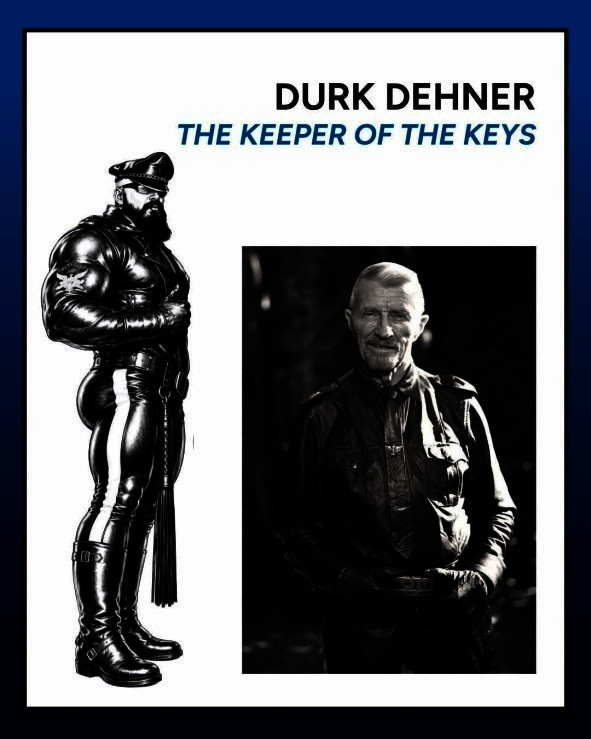
There are men who inherit history, men who record it, and men who spend their lives making bloody sure it is not thrown into the rubbish bin when fashion changes. DurkDehner belongs firmly to the last category. For more than four decades, his name has been inseparable from that of Tom of Finland. That association alone would have secured him a place in the history of gay male culture. But to describe Durk simply as Tom’s partner, collaborator, model, muse, archivist, or a co-founder of the Tom of Finland Foundation is to miss the larger point.
Durk did something considerably harder. He stayed. He stayed when erotic art was treated as pornography rather than culture. He stayed when homosexual desire was something respectable institutions preferred neatly concealed. He stayed through AIDS, censorship, changing generations, changing vocabularies and changing ideas about what gay culture was supposed to look like. Most importantly, he always knew what the Old Guard understood instinctively: preservation is not nostalgia. It is duty.
It is easy now to forget how radical Tom of Finland once was. Today, Tom’s drawings hang in museums and galleries. They appear in handsome art books, scholarly studies, exhibitions, fashion collaborations and prestigious collections. His men have become instantly recognizable: boots polished, leather stretched tight, muscles exaggerated beyond anatomical plausibility, trousers struggling heroically against their contents — and, of course, those signature gigantic c*cks.
Yet Tom did not emerge from the respectable end of the art establishment. His natural habitat was the erotic underground. And that distinction matters. These pictures circulated among homosexual men who recognized something in them long before curators decided they were culturally significant. Tom showed gay men not as tragic figures, psychiatric cases, delicate victims or objects of pity, but as physically powerful creatures enjoying themselves enormously.
They grinned. They cruised. They f*cked. They occupied space. They were unapologetically male, unapologetically masculine and unapologetically homosexual. There was humor in Tom’s world, but very little shame. For generations of gay men taught that their sexuality should be hidden, apologized for, medicalized or punished, that was revolutionary.
Durk Dehner recognized the importance of that vision early. He began working with Tom in the late 1970s and became instrumental in bringing his work to a wider American audience. What developed between Durk and Touko Laaksonen — the Finnish man behind the famous signature — became a remarkable personal, artistic and professional relationship. In 1984, the two men established the Tom of Finland Foundation. Its original purpose was
straightforward: to preserve Tom’s life and work. It would become something considerably larger.
Our history has repeatedly disappeared. Letters destroyed by frightened families. Photographs thrown away after deaths. Bars demolished. Clubs closed. Magazines discarded as pornography. Personal collections broken apart. Men dying without heirs who understood what they possessed. Entire worlds have vanished because somebody decided they were embarrassing. Erotic history is particularly vulnerable because sex makes respectable people nervous.
Durk understood this. Under his stewardship, the Foundation’s mission expanded beyond protecting Tom’s own work. It became a refuge for erotic art more broadly — precisely the material most vulnerable to censorship, neglect and institutional embarrassment. That achievement deserves to be understood for what it is. Saving respectable art is easy.
Saving the material everyone else wishes had never existed requires considerably more backbone.
Someone had to decide that these drawings mattered before museums agreed. Someone had to preserve the photographs before academics wanted to study them. Someone had to keep the correspondence and remember the names. Someone had to keep the keys.
Durk did.
Then there is the house. TOM House in Los Angeles is more than a building associated with a famous artist. It represents something increasingly rare in gay culture — continuity. Walls remember. Rooms remember. Leather remembers. Places acquire meaning because men inhabit them, argue in them, create in them, drink in them, desire in them, f*ck in them, grow old in them and eventually leave them to somebody else. Culture requires physical memory. A digital archive cannot reproduce the sensation of standing somewhere where the history actually happened.
For decades, the Foundation cultivated precisely that kind of living continuity: artists, collectors, leathermen, fetishists, photographers, historians, admirers and the merely curious passing through the same doors. That matters because communities are not built exclusively from manifestos. They are built around a kitchen table, around an easel, around a bar. And sometimes around a man in leather saying: “Come inside. You should see this.”
One of Durk Dehner’s greatest contributions may ultimately be that he refused to let Tom of Finland’s legacy become a mausoleum. The easiest thing after Tom’s death in 1991 would have been to freeze him permanently in amber. Instead, the Foundation broadened its mission to protect and encourage erotic artists whose names were not Tom of Finland. That distinction is enormously important. A legacy survives only when it produces descendants.
Preservation without creation eventually becomes taxidermy. By providing space for erotic artists, exhibitions and cultural exchange, the Foundation helped establish a proposition that should never have required defending: erotic art deserves not merely to survive; it deserves to continue being made. Sexual imagination is not an embarrassing appendix to culture; it is culture.
Gay men understood this long before museums did. Our bars were cultural institutions. Our pornography recorded our fantasies. Our leather clubs forged codes of gear, conduct, hierarchy and belonging. Our illustrators created mythologies. Our photographers documented bodies and tribes that respectable society either ignored or condemned. Tom understood that. Durk understood it too.
There is something wonderfully uncomplicated at the heart of Tom’s work. Desire. Not a dissertation about desire. Not an ideological explanation of desire. Desire itself. Men looking at men. Men wanting men. Men enjoying being wanted by other men. Leather, boots, uniforms, muscles, motorcycles, cops, sailors, laborers, bikers — an exaggerated masculine universe constructed through the imagination of a homosexual man fascinated by other men.
Durk has spoken of the freedom and “happy sexuality” embodied by Tom’s work. Those two words explain an extraordinary amount. Happy sexuality. Consider how revolutionary that once was. For generations, homosexual men were taught that their desires should produce shame, secrecy, guilt or punishment. Tom drew the opposite. Desire produced pleasure.
His men did not ask permission to exist. They certainly did not apologize for wanting one another. They simply got on with it.
Preferably in boots.
There is another reason Durk deserves recognition. Tom of Finland became an icon. And icons are tricky bastards: sooner or later, everyone wants to see a little of himself staring back. Once an underground artist becomes culturally valuable, institutions arrive.
Academics arrive. Corporations arrive. Curators arrive. Marketing departments arrive. Each generation discovers the work anew and inevitably attempts to interpret it according to its own preoccupations. But somewhere beneath all those interpretations remains Touko Laaksonen: a Finnish homosexual man sitting at a drawing table creating images of the men he wanted to see.
Durk knew that man. Not the brand. Not the academic subject. Not the museum acquisition.
The man.
That gives his testimony and stewardship a significance no later curator could ever hope to match. He knew the humor behind the enormous c*cks. He understood the fascination with uniforms, boots and leather. He understood the masculine camaraderie and sexual confidence. He understood that Tom’s men were not grim monuments to masculinity. They were having a bloody good time. And he understood what those images meant when they were still passed between men who could not take their acceptance for granted.
That distinction matters.
If Tom was the God of homosexual masculine eroticism, Durk was his St Peter — the keeper of the keys, the builder of the Church, and the man who carried his Gospel forward. The analogy is deliberately grand because the achievement was grand. Tom created the vision. Durk helped ensure that the vision survived. For decades he promoted it, defended it, preserved it, contextualized it and helped build the institution through which future generations could encounter it.
That is what custodianship means. You inherit something. You look after it. You add something worthwhile of your own. Then you hand it forward. The chain matters more than the individual link. There is something profoundly Old Guard about that concept. Leather understood succession long before corporations discovered the word “legacy.” Knowledge passed from man to man. Protocols were taught. Stories were repeated. Objects were inherited. Names were remembered. Rank carried responsibility. The leather might belong to you today, but you understood that you were merely one man in a chain stretching backward and, if you did your job properly, forward.
Durk has been both the link and the chain for more than forty years.
There is, however, an ugly irony in what is happening around Tom’s legacy today. The current management of the Tom of Finland Foundation appears increasingly determined to reinterpret Tom’s history and philosophy through the fashionable vocabulary of contemporary queer theory, retrofitting a distinctly homosexual male erotic vision to suit an ideology that came much later.
In parallel with this process, Durk Dehner — the man who stood beside Tom, co-founded the Foundation with him and devoted almost half a century to preserving his work — has himself become the target of what can only be described as a particularly sordid campaign of cancellation and ideological obliteration, with his role being diminished and his name systematically erased from the very history he worked so hard to preserve.
And the betrayal runs deeper: in its undisguised zeal to “queer” Tom of Finland, the current leadership is ultimately emasculating Tom himself. Touko Laaksonen needs neither twenty-first-century theory to explain what he drew nor retroactive ideological improvement. His
men were born from his own homosexual desire, his fascination with masculinity, uniforms, leather, muscles, male bonding and sex between gay men. His work survived perfectly well on its own.
The cultural record cannot be rewritten merely because its principal custodian has
become inconvenient to the present establishment. Remove Durk from Tom’s history and you falsify the record; remove Tom’s own erotic intentions from his art and eventually Tom of Finland becomes little more than a convenient name attached to somebody else’s ideology.
In our ecclesiastical metaphor, the present-day Church has decided to strip St Peter of his keys. And not merely the keys. It has also begun to revise the canon and rewrite the Gospel itself. Meanwhile, Durk — our St Peter — has been sentenced to martyrdom by the very Church he spent most of his adult life building.
There is an uncomfortable truth about cultural preservation. We usually notice its importance only after something has disappeared. A bar closes, and suddenly everyone remembers what it meant. An elder dies, and suddenly everyone wishes somebody had recorded his stories. An archive is dispersed, and suddenly scholars begin asking where everything went. A generation disappears, and the generation behind it discovers that Google cannot answer every question.
Someone has to keep the photographs. Someone has to remember the names. Someone has to know which drawing came from which year, which story belongs to which man, which object mattered and why. Someone has to remember what the words meant before somebody decided they required updating.
Someone has to keep the f*cking keys.
For much of the history of Tom of Finland and the institution created to preserve his legacy, Durk Dehner has been that man. That deserves gratitude. Not the polite gratitude of an awards dinner. The deeper gratitude owed to a custodian. Because without custodians, subcultures eventually become costumes worn by people who have forgotten what the clothes once meant.
Tom gave generations of homosexual men a magnificent fantasy of themselves: muscular, sexual, masculine, mischievous and gloriously unashamed. Durk helped make certain those men did not disappear when their creator put down his pencil for the final time.
He kept the door open.
And generations of men walked through it. I was one of them.
Whatever happens to the institution now, whatever language future curators end up using, whatever theories future academics construct around those magnificent men in leather — that fact belongs to history.
Erasing it is a crime; forgetting it is a disgrace. Durk Dehner was there.
Durk Dehner kept the keys.
— Dom of Pigland

Dom of Pigland is a gay Leatherman, Old Guard leather enthusiast, community organizer, and filmmaker. He has been active in the leather, BDSM, and fetish scene for over a decade. First Runner-Up at Mr. Leather Russia 2021, he met his partner, Master Marcus, the contest winner, during the competition. Together they have organized leather socials, BDSM events, educational conferences, and community-building initiatives. His award-winning documentary FETISH IN E[X]ILE received the Night Award for Best LGBTQ+ Film at the 2026 Night of Shorts international online film festival in Milan, Italy, an Honorable Mention at the 2025 BDSM Fetish C Kink Film Festival in Barcelona, Spain, and was a finalist for the 2025 Fetish Film of the Year at the Darland’s X-Awards in Antwerp, Belgium.