
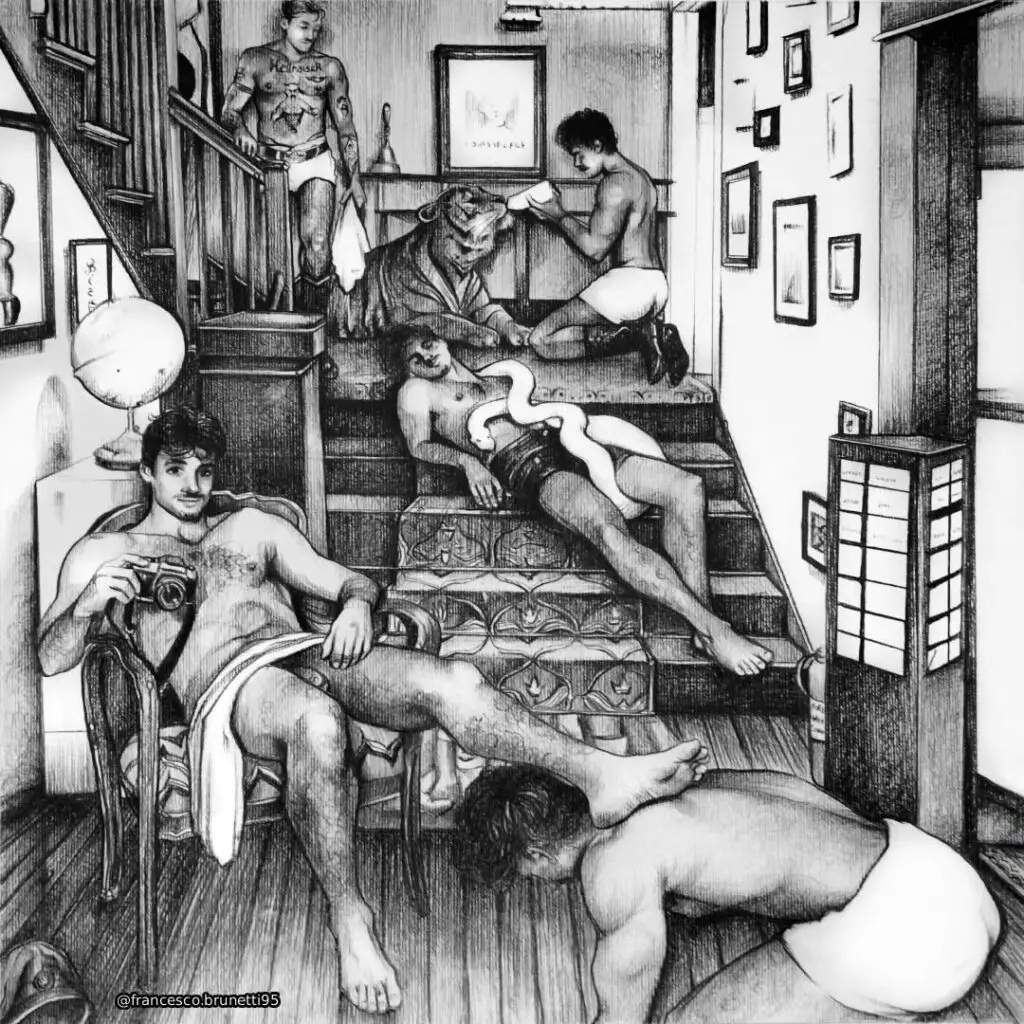
For four decades, the Tom of Finland House in Los Angeles has served as both a repository of the legacy of the iconic gay Scandinavian [Note: While Finland is a Nordic country, it is not part of Scandinavia.] erotic artist and as a hub for hundreds of queer erotic artists from around the world who followed in his footsteps. But between June and October, the Tom of Finland Foundation, which maintained the house, abruptly cancelled all of its programming, laid off all of its staff and announced surprise plans to relocate the collection, with some fearing they plan to take it all 2,000 miles away to New York City.
Tom of Finland was the pseudonym used by artist Touko Laaksonen, whose drawings of hypermasculine and hypersexualized men from the 1950s to his death in 1991 were highly influential in the developmentof gay culture and mainstreaming of queer art. Works of Tom’s that were originally relegated to beefcake magazines and an underground mail-order business now hang in galleries across the globe, including New York’s Museum of Modern Art and the Museum of Contemporary Art in Los Angeles.
Tom moved to Los Angeles in the 1970s, and from 1980 to 1990 lived with his partner Durk Dehner in the sprawling 14-room California Craftsman house in Echo Park that’s now affectionately known as TOM House. Dehner still lives in the house today, though the majority of the building is used as an archive for Tom’s collection and as artists’ studios. Together with Dehner, in 1984 Tom established the Tom of Finland Foundation, a charitable organization devoted to preserving his own art and generally fostering and promoting queer erotic art.
In addition to Tom’s own work, he and Dehner acquired thousands of pieces of art, including works from notable queer artists like John Waters and Robert Mapplethorpe. In recognition of Tom’s contribution to the arts, the City of Los Angeles designated the Tom of Finland House as a historic-cultural monument in 2016.
Until recently, the foundation also ran tours of the house, art workshops, markets and an annual erotic art and culture festival. It also hosted artists from around the world in coveted residencies at the house.
All of that came to an end in June. The foundation stopped paying rent to Dehner for its use of TOM House and laid off all of its staff.
Dehner then attempted to serve an eviction notice [Note: The document served was actually a Notice of Termination (warning) rather than a formal court-filed eviction notice.] on the foundation. He says he resorted to that step because the foundation had stopped returning his messages, and that was the only way he could find out what was going on. In the end, no eviction notice was actually served. “What we were attempting to do was to get them to come to the table and to discuss what was going on, because they had not had any communication with me at all about not paying rent, utilities, off-site storage. We’ve never had that conversation,” Dehner tells Xtra.
In the meantime, all of the foundation’s programs were suddenly terminated with little or no notice given to the artists involved.
Georg Meyer-Wiel is a German erotic artist who’s based in London. He came to Los Angeles in July for a scheduled residency at TOM House, only to find out on arrival that all the programming to support it—workshops, meetings, publicity—was cancelled. “This residency cost me a lot of money,” says Meyer-Wiel. “I spent nearly $20,000 to be there and I’ve gotten nothing out of these shitters because they cancelled everything. There was no promotion, there was nothing. Not even an apology.”
Francesco Brunetti, an Italian artist also based in London, was only told two weeks before his residency was to begin in September that it was being cancelled altogether. “This was a huge deal. I made a whole plan, even with my company in the U.K. I had to ask for a sabbatical, all the arrangements with the apartment I rent in London,” Brunetti says. After he received notice of the cancellation, Brunetti spoke with Dehner directly, and Dehner invited him to complete the residency at TOM House without the foundation’s participation. “I still came here because I spoke with Durk and he explained the situation to me, and he said that I could still do this because it means a lot to me,” he says. “It is horrible what happened. You don’t treat people like that.”
Dehner says what money does come in has been wasted on legal fees and PR. The board has told him that it will only communicate with him via lawyers, and he says he’s spent close to US $20,000 on his own legal fees just to communicate with the board. He worries that with no money coming in, the foundation may resort to selling parts of Tom’s collection that are already in its possession. For his part, Dehner has already begun to sell artwork from his personal collection to support himself and keep up with required maintenance on the Tom of Finland House. He says he recently sold an original piece he bought at Tom’s first exhibition in Los Angeles to pay for a new roof for the house.
And the future of TOM House remains unsettled.
Dehner, who’s now 77, says he had always planned to leave the house and its contents to the foundation after he died. Now he speculates that the foundation wants to sever its ties to the city Tom called home altogether. “I thought I would pass and everything that was mine would be theirs. But they don’t want it. They want to separate and move whatever they want to New York and set up shop there,” Dehner says. “It’s not what Tom would have wanted. He wanted a community. He wanted the foundation to inspire others to be creative and express themselves without limitation.”