
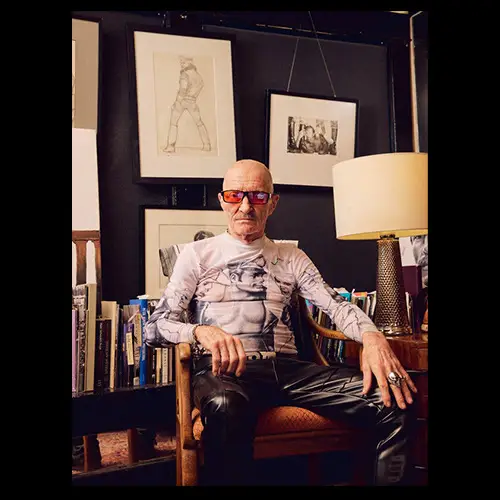
Durk Dehner was Tom of Finland’s muse, model and business partner before the artist died in 1991
Credit: Damien Maloney for The New York Times
Long before the obsession with looksmaxxing and testosterone-boosted biceps, the artist Tom of Finland began to build a cult following in the 1950s around his illustrations of beefy bikers and leather-clad policemen so muscular they practically exploded out of their outfits.
More than three decades after the artist’s death in 1991, his gay erotica is now held by multiple major museums and featured in fashion shows, films and nightclub bathrooms. The Finnish artist’s former Los Angeles home, the TOM House, is a city landmark and a symbol of the gay community in Echo Park, where it sits.
But who exactly deserves to guide the legacy of Touko Laaksonen (the artist’s real name) has become the subject of an increasingly bitter dispute between the artist’s former muse, model and business partner, Durk Dehner, and the Tom of Finland Foundation, a nonprofit tasked with protecting the artist’s work.
Dehner, a Canadian businessman and leatherman, founded the nonprofit with Laaksonen in 1984, and served as president until 2025, when he resigned under pressure from other trustees. Images had resurfaced of him wearing Nazi regalia. Dehner apologized and said they were remnants from an era when some people in fetish communities dressed as Nazis to appear subversive.
By the time Dehner met Laaksonen in 1978, the artist’s illustrations were already famous in the gay community. They circulated in bodybuilding magazines that were popular decades earlier, like Physique Pictorial. Though the filmmaker John Waters, who discovered Laaksonen’s drawings in the late 1950s, referred to him as “one of the founders of filth,” museum curators came to celebrate his illustrations as beacons of unashamed sexuality made at a time when gay relationships were taboo.
“It’s not like party-and-play, hidden-hotel-rooms business,” the curator Stefan Kalmár said in 2015 when he organized a retrospective of the artist at Artists Space in New York.
As Laaksonen’s business manager, Dehner worked to coordinate the artist’s financial interests through licensing agreements and other business deals. In 1979, Dehner purchased what became the TOM House with three other people. Dehner lived there and Laaksonen would stay there intermittently over the next decade until his death.
The house soon became a place for chosen family; queer people kicked out of their families would temporarily stay there, and artists would volunteer their time to study the archive of Laaksonen’s work. For years, the foundation’s offices were located in the home’s attic and it leased space for resident artists to live there. A collection of 1,500 of the artist’s works were stored in the house as well.
Dehner has started a website called Save TOM House,” where he posted letters of support signed by more than 60 artists and others. “A man who stood the watch for 40 years does not become disposable,” a filmmaker named Dom of Pigland said in his letter, “merely because others have grown comfortable occupying the institution he helped build.”
Robert Knox Hayes, the foundation’s new chairman, denied there are any plans to move the foundation. “It’s a California-registered foundation,” he said. The artworks were moved from the house, he said, because it’s located in an area where it’s difficult to secure fire insurance.
Many former employees and former artist residents of the foundation still believe that Dehner was unfairly treated, given all he has devoted to the leather community and gay erotic art.
“Durk is the last living connection to Tom,” said Richard Villani, who previously served as the foundation’s director of global partnerships and exhibitions. “Durk knew every player in that world as it blossomed and bloomed in the 1970s and 1980s.”
Hayes, who lives in Manhattan, said he doubted that he would be able to regain the trust of the foundation’s longtime supporters, many of whom are from the local community and are very loyal to Dehner. He said that he regretted not being more transparent about the nonprofit’s financial health as he dug into the paperwork.
“Durk has made this queer oasis in Echo Park,” he said. “And it seems like I’m trying to burn the house down to them.”
But in the future, Hayes hoped to find common ground: “I want to rebuild together rather than apart.”
Durk has operated with both legal counsel and board approval.